Skip to content

Main

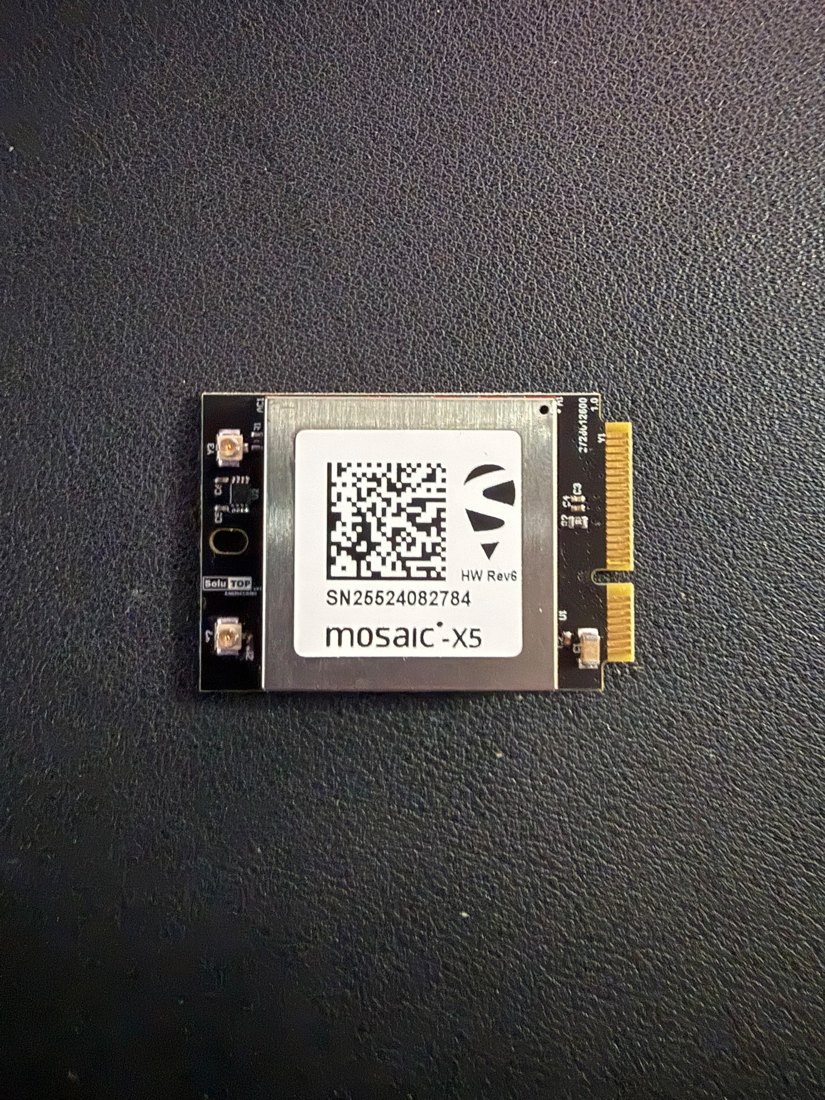
The Main board is the PCB onto which the mosaic-X5 GNSS module is soldered, together with all the surrounding electronics: power, interfaces, storage and indicators. The mosaic-X5 module (with QR label, serial number and HW Rev1 marking) is mounted at the centre of the board.

MSX Main: mosaic-X5 card with mini-PCIe connector
The Main board: the mini-PCIe-format card with the soldered mosaic-X5 module and, on the edge, the gold mini-PCIe contacts for plugging into the carrier.

Specifications and dimensions

Main functions:

  • housing and powering of the mosaic-X5 module;
  • generation of the supply voltages (DC/DC) and protections;
  • level shifting and routing of the UARTs;
  • USB-C interface to the host;
  • microSD slot for raw-data logging;
  • status LEDs and LOG button;
  • mini-PCIe connector to the Carrier board.
Characteristic Value
Dimension (measured side) ≈ 62.8 mm – almost square
PCB colour black (dark solder mask)
Mounting holes 4, at the corners
GNSS module mosaic-X5 soldered at the centre (31 × 31 mm)
Hardware revision HW Rev1 (silkscreened)
Serial number shown on the module label
Input voltage 5 V (USB-C)
Module working voltage 3.3 V (generated on-board)
Coupling to the carrier mini-PCIe connector (see mini-PCIe interface)

Note

The full dimensions (both sides, thickness, hole spacing) must be taken from the dimensioned mechanical drawing. The designators mentioned come from the SoluTOP board family of the same generation and represent the typical layout. (to be confirmed on the schematic of the production revision)

Functional sections

Section Typical components Notes
GNSS module mosaic-X5 (soldered) RF/GNSS core, SMD-mounted at the centre of the board.
Power DC/DC, ferrites (L1…), PTC fuse (F1) 3V3 generation, EMI filtering.
Serial interfaces buffer/level shifter (U1, U4) Adapt the logic levels of the UARTs.
USB USB-C connector, CC resistors (5k1) Power + data to the host.
Storage microSD slot (CN1) Raw-data logging.
Indicators LEDs, buzzer (U7) Receiver status.
Control tactile button (P1) LOG / function button.

Connectors and interfaces

microSD slot CN1
The microSD slot (CN1) for raw-data logging.
Ref. Type Function
J6 / J8 USB Type-C Host + power (USB data + 5 V)
J1, J2, J5, J7 JST SH 4-way (1 mm) Serial / auxiliary I/O (UART, PPS)
J9 / J10 JST XH 2-way Power / battery
J11 Header 2×3 (2.54 mm) Programming / debug
J12 6-way header (2.54 mm) General-purpose I/O / testing
CN1 microSD push-pull Storage (logging)

Note

Not all connectors are fitted in every configuration. Externally, on the mini carrier, the only interface is USB-C (see Carrier mini).

USB-C — primary interface to the host: 5 V power + the module's USB data line. The CC resistors (5.1 kΩ) set the device as a USB device powered from the cable.

UART (TTL 3.3 V) — the module's serial ports for NMEA-0183 output, SBF output (logging/post-processing) and RTCM 3.x correction input.

Warning

The UART lines are at 3.3 V. Do not connect them to RS-232 signals (±12 V) without a converter: the module would be damaged.

PPS / EVENT — synchronisation pulse (Pulse-Per-Second) and inputs for time-tagging external events, available when provided by the configuration.

Power

USB-C 5V ─► [Fusibile PTC F1] ─► [Filtro EMI/ferriti] ─► [DC/DC] ─► 3V3 ─► mosaic-X5
                                                               └─► interfacce / LED
Item Ref. Function
Input protection F1 Self-resetting PTC fuse 0.75 A.
EMI filtering L1, L2, L4, L5 Ferrite bead on the supply lines.
DC/DC conversion regulator Generates the stable 3.3 V.
ESD protection Schottky / TVS diodes Transients and reverse polarity.

mosaic-X5 module consumption: ~ 0.6 W typical; the total depends on the active interfaces.

Tip

Use a USB-C power supply of at least 5 V / 2 A and good-quality cables: long/thin cables cause voltage drops and resets.

LEDs, LOG button and states

Status LEDs
The status LEDs lit (detail of the LED row).

The LEDs convey the receiver status at a glance.

Note

The mosaic-X5 module provides two general-purpose LED output pins (max ~10 mA), driven by the firmware. The final number and mapping of the LEDs on the MSX board are to be confirmed in the firmware.

Colour Typical meaning State
Green Power System powered and operational.
Bright green RTK fix RTK fixed solution (centimetre precision).
Yellow DGPS / float Differential solution not yet fixed.
Blue Communication Activity on the data interface.
Red Error / no fix No solution or error.

Typical sequence: power-on → steady green LED; satellite search → blinking fix LED; RTK fixed → steady bright-green LED (you can start surveying).

LOG button

Reset and LOG buttons
The two buttons: reset and LOG (start/stop recording).

The tactile button (P1) is used as a LOG button to start/stop raw-data recording in the field, without a PC:

  • 1st press → starts the logging stream (e.g. SBF at 100 Hz);
  • 2nd press → stops the recording and saves the trajectory.

It is the command used for monitoring athletes on the track (see 400m on the track). An optional buzzer (U7) gives acoustic confirmation of the press and of reaching the RTK fix.

3D model

Interactive 3D model of the Main board (with mosaic-X5 module). It rotates automatically; drag to rotate, scroll to zoom, right-click to pan.

drag rotate  ·  scroll zoom  ·  right-click pan