Mosaic X5
The Septentrio mosaic-X5 module is the heart of the MSX receiver. It is a multi-frequency, multi-constellation GNSS receiver in an extremely compact form factor, with geodetic-grade performance.
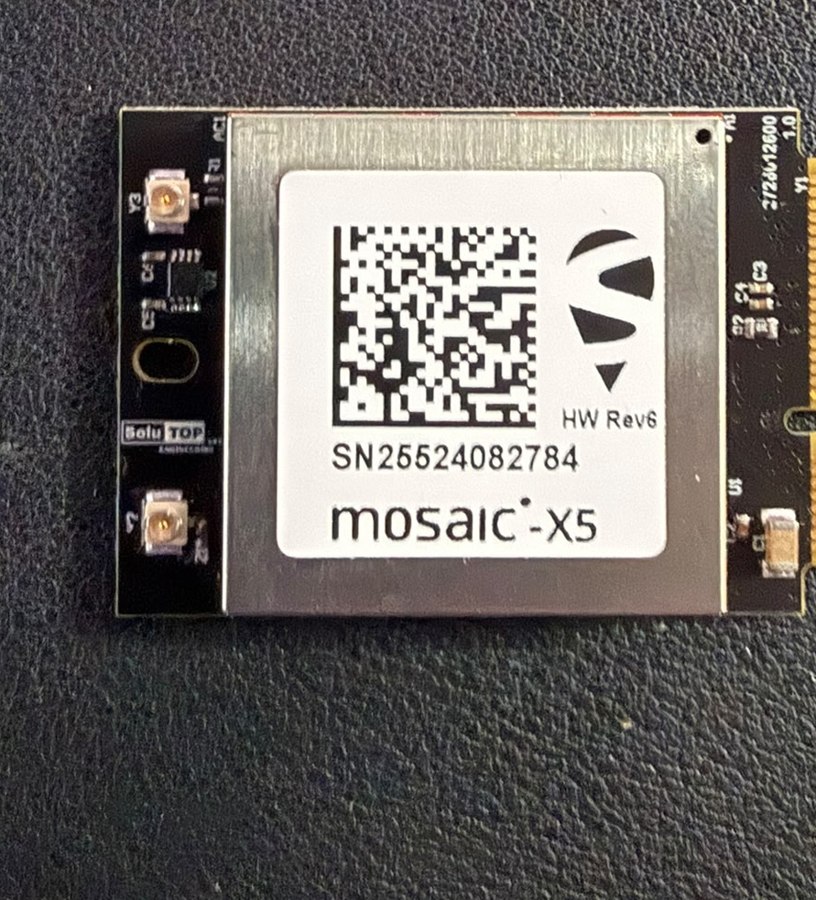
HW Rev6) and the U.FL antenna connectors.Module technical specifications
| Parameter | Value |
|---|---|
| Form factor / dimensions | Compact module 31 × 31 × 4 mm |
| Constellations | GPS, GLONASS, Galileo, BeiDou, QZSS, NavIC, SBAS |
| Frequencies | Multi-band (L1 / L2 / L5 and equivalents for the other constellations) |
| Channels | Tracking of all constellations and current and future signals |
| Update rate | Up to 100 Hz |
| Horizontal accuracy (RTK) | ~ 6 mm + 1 ppm |
| Vertical accuracy (RTK) | ~ 1 cm |
| Timing precision | 5 ns |
| Typical power consumption | ~ 0.6 W |
| Interfaces | USB, UART ×4, SD card interface, Ethernet (on host carrier) |
| Auxiliary signals | configurable PPS, 2 EVENT inputs, 2 status LED outputs |
| Interference mitigation | AIM+ technology (advanced anti-jamming and anti-spoofing) |
| Operating temperature | typically -40 °C to +85 °C (see the module datasheet) |
Note
The values shown are the public specifications of the mosaic-X5 module. The actual performance of the MSX system also depends on the antenna, the RF cable, the quality of the RTK corrections and open-sky conditions.
Interfaces exposed by the module
The mosaic-X5 provides a rich set of interfaces:
- USB – primary interface to the host (configuration, data, streaming).
- UART – up to 4 TTL serial ports; typically used for NMEA, SBF and RTCM corrections.
- SD card – raw-data logging to microSD.
- PPS – one-pulse-per-second timing signal (Pulse-Per-Second).
- EVENT – inputs for time-tagging of external events.
- LED – status outputs driven by the module firmware.
Info
On the mini carrier only USB is exposed externally: the module's other interfaces (UART, PPS, EVENT…) stay internal and are not brought out to connectors. They will be available on the future carriers, reusing the same Main through the mini-PCIe interface slot.
Supported data formats
- SBF (Septentrio Binary Format) – high-efficiency native binary format.
- NMEA-0183 – standard sentences (GGA, GSV, RMC, GSA, ZDA, VTG, GST…).
- RTCM 3.x – differential corrections in/out (also base/rover).
- RINEX – via raw-data logging for post-processing.
Configuration
The module is configured through the built-in web interface (Septentrio web
UI / RxTools) by connecting it over USB and opening http://192.168.3.1 in
the browser. In the MSX system the factory configuration sets up the ports for
typical use entirely over USB (host on USB-C, RTK corrections from an
external NTRIP client).